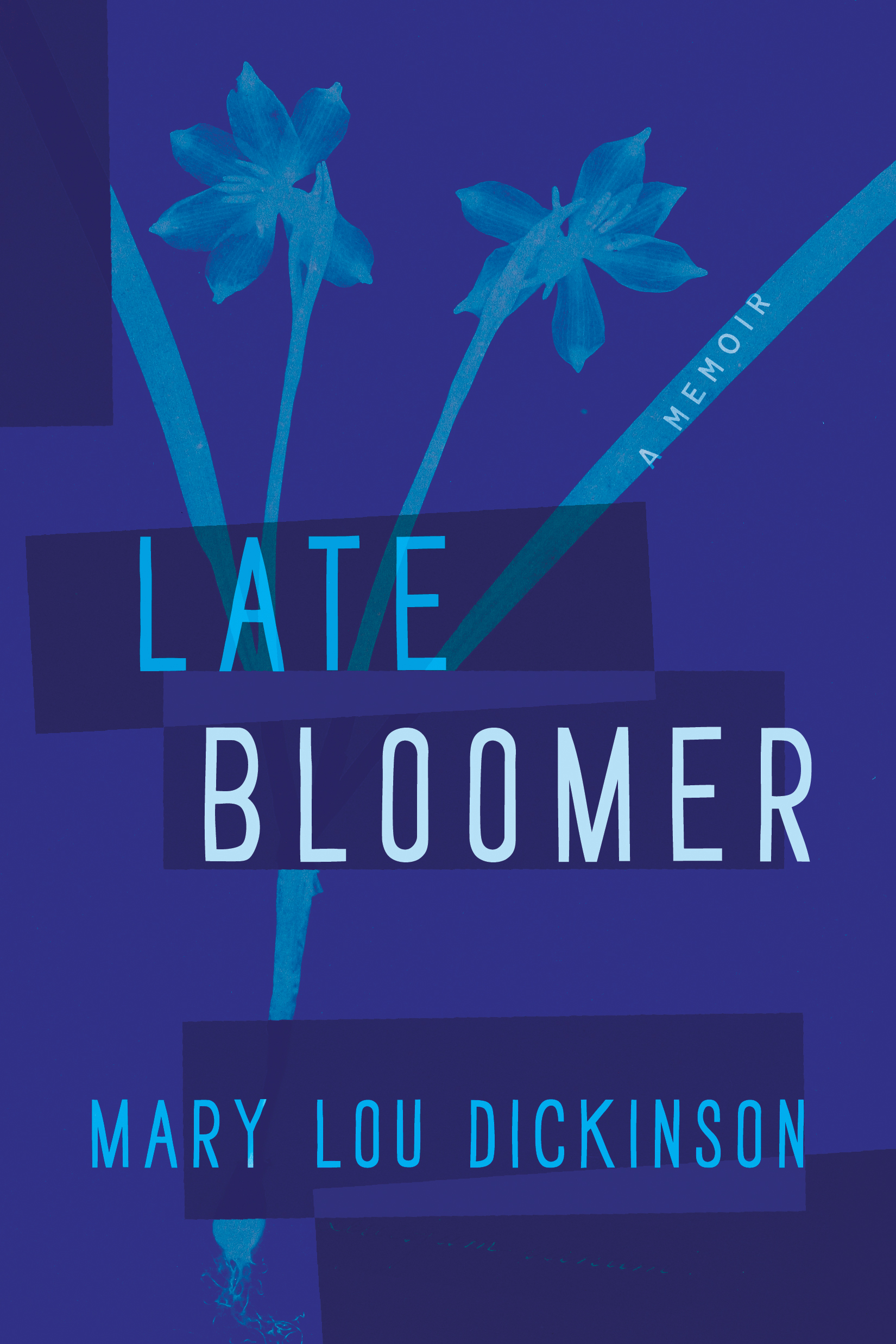
Born in the shadow of World War II, Mary Lou Dickinson came of age in an era that expected women to conform—but she never did. This powerful memoir traces her path as a feminist writer of the Silent Generation, working with the women’s movement and working to support the survivors of sexual assault. Though she had long published stories in literary magazines, it wasn’t until the age of 70 that her first book was published, proving that it’s never too late to claim one’s voice.
“Late Bloomer is the autobiography/memoir of a writer. The writer is a late bloomer as her first published book comes late in life, but the woman has been striving and blooming all her life. There is a profound message as seen through her story – a universal and eloquent message – that teaches us to choose to bloom.”
—Paula de Ronde, librarian, Toronto Public Library
Mary Lou Dickinson is a feminist author who emerged from the “Silent Generation” (a child during World War II) to a long struggle to find her voice. Told what women could not do, she was determined to find a path through the noise to achieve different goals than those available. Among many jobs over the years to support herself, her children and her writing, she worked as a counsellor on a crisis line for women in situations where they experienced violence (emotional, physical, sexual, etc.) against them. She writes thoughtful, insightful fiction that often highlights social justice issues.
PROLOGUE:
ONE DAY IT HAPPENS
What will I do to celebrate my seventieth birthday? I wondered as that date approached. But rather than feeling festive, I was grieving. It felt as if it could be over the loss of youth, the loss of all the opportunity that lies ahead when one is younger. Instead, I was letting the white and grey show through my hair and was being offered seats on the subway. I felt like the world’s grandmother until I looked in the mirror and, while I saw a woman almost 70, she was not some modern version of Methuselah. And although I had not yet published my first book, I hadn’t given up yet.
Following almost a lifetime of writing and raising two children as a single parent as well as working at various other jobs, there were a few of my short stories in literary periodicals. Yet no book. I was determined to have that happen even though how I would reach that goal continued to elude me. I decided I would take short courses at the Humber School for Writers. At their suggestion, I joined a writing group. But five years had passed and although I’d submitted various manuscripts, the contract for that book hadn’t yet happened.
That evening, I went to the Toronto Women’s Bookstore to hear two authors read from their new books. One of them had presented a workshop at the Helpline where I worked for the last fifteen years before retirement. And she had mentioned the launch. Over the evening, I met Luciana Ricciutelli, the editor of the small press that had published them.
“I’m looking for a collection of short stories to publish,” she said, inviting me to submit some. “Two or three.”
Inanna Publications had recently started to publish trade books and was known best until then for a scholarly publication, Canadian Woman Studies. I had previously purchased the feminist, academic journal for the crisis line. It was a fine journal, but I could not imagine my stories fitting into such an erudite academic atmosphere. Nonetheless, I took her invitation seriously and considered how to submit my manuscript, then in the hands of Margaret Hart, my agent, after attendance at the summer program of the Humber School for Writers.
While I was attempting to figure out what to submit, I had my tarot cards read by Elizabeth Greene, a colleague from a writing studio in Banff, Alberta a few years earlier. It was positive, especially in revealing the imminent prospect of matters coming to fruition. I corresponded with Margaret. When she said go ahead and submit the manuscript myself with her offer of representation if it were accepted, I sent off a query letter to Luciana with three stories.
Within twenty-four hours, I received a request to submit my complete manuscript. From my previous experience with publishers, I had expected to wait a long time. But around two weeks later, I opened an e-mail to find an acceptance for the short story collection. Such a speedy turnaround, almost unheard of in my knowledge or experience of the publishing world, astonished me. Not only that, but Luciana suggested publication the following spring. I wondered if I were dreaming. It felt as if my success had happened overnight. It was, of course, an illusion. It had taken over forty years, time that spanned a lifetime of writing, revising, submitting, and waiting. And waiting.
I reread the words of the email − Inanna wants to publish your stories. All night, my heart pounded. As I lay there wondering if this was the precursor to a heart attack, I kept reminding myself this was good stress. After three hours of sleep, I arose feeling ill rather than ecstatic.
I nonetheless managed to correspond with Luciana, receive a copy of a contract, buy the model contract provided by the Writers’ Union of Canada and ask Margaret Hart to represent me. On the afternoon I went out to mail the signed contract, I bought an ice cream cone. As I sat and watched the crowd crisscross the tile floor of the mall at Yonge and Eglinton, I thought that most people would probably order champagne as their initial celebratory gesture.
Having the book appear just before my birthday was the best gift I could hope for.
I began to think of answering questions for publicity. I had been told the way to do this was to create a story about my own life that would appeal to journalists and critics. “Well, I had thought I would deal with this decade with massive denial, but this book has outed me. So here I am, a writer with her first book at almost seventy. It sounds like a late start, but I’ve been writing since I was a child. And I intend to keep on going.” I would tell the story about the poem about snow my writer grandmother had published in her column.
“This is what old looks like.” The way Gloria Steinem said, “This is what sixty looks like.”
I would pave the road for the baby boomers, not only as a writer but across the spectrum of what older people were doing.
This acceptance, my book that was finally published in 2007 with the rather ironic title, One Day It Happens, created a burst of energy. There were no blank pages in my life at that moment. And as I spread the good news, I witnessed broad smiles crossing faces, eyes lighting up.
In one of my short stories, I included a fragment of an unpublished poem written by my friend, Brydon Gombay, One Day It Happens.
One day it happens and the telephone rings.
Or the e-mail arrives.
And what do you say? What do you say?
For once, the news was wonderful!
Let me tell you the good news!
How I felt about myself as a writer began to change subtly. There was a book launch in downtown Toronto where friends and acquaintances gathered to celebrate with me. They listened as I read, the light shining through the stained-glass window behind me. To my surprise, almost everyone bought at least one copy.
And One Day It Happens received a much-coveted review in the Globe and Mail. That fall, my first book tour unfolded with readings in Vancouver and stops in Ste. Anne and Winnipeg, Manitoba. I had crossed a metaphorical bridge to a new stage of my life. At 70 years of age, doors began to open.
In Late Bloomer, Dickinson’s passion for writing is the current that drives the memoir through a life full of astonishing and disparate twists and turns. She takes the reader from the mining town of Val d’Or in Quebec to Toronto. Combined with her travel experiences, her memoir is a rich landscape of colour and sound where the reader meets both intimate family members and public faces. Her story is grounded in fascinating Canadian history as she discovers her global genealogy. She easily transitions from past to present and, after years of perseverance, ends her journey with the satisfaction of having accomplished her life’s goal. A great read.
—Valentina Gal, author and storyteller
Mary Lou Dickinson’s world is marked by courage of conviction, perseverance and success against all odds. I am captivated by her craft, her vivid focus on intricately layered details, narrated with almost an ease of a post- expressionist form of storytelling. A compelling memoir, with a masterful blend of personal reflection and cultural commentary, written with sharpness, clarity and humility. A must read.
—Dr. Anubha Mehta, author, Peacock in the Snow
A memorable portrait of a strong, persistent Canadian woman writer, shaped by landscape and by history. Mary Lou Dickinson’s life bloomed early, with marriage and motherhood, travel and friends, but the writing flowered late: her first book, the ReLit finalist One Day It Happens, was published just before her seventieth birthday. Late Bloomer is the story of literary arrival after a lifetime of writing, a reminder that everyone has the right to strive and an affirmation of the worth of that striving.
—Elizabeth Greene, author, No Ordinary Days